
brine.dev

words

The Image IS Your Character Sheet
2026-01-11

center

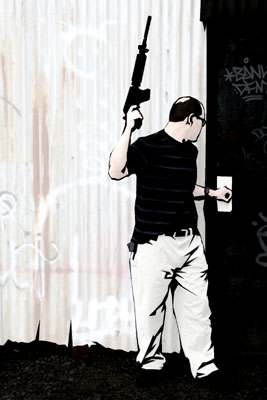
I bumped into this thread from Vincent Baker about character sheets. In it, he shows an image of a character and then brilliantly defines the character from the image:

"He's got some immediate evident qualities: his gun, his attention to his surroundings, his energy/adrenaline/capacity for violence/will to action, and it looks like maybe he's done this thing more than once before."

Mr. Baker (I mean, it's Vincent Baker... RESPECT! So yes, Mr.) explains how RPG design should handle three types of character qualities: effectiveness, resource, and positioning. Yes. Cool. But then Mr. Baker fucks up and suggests we translate all that into a character sheet.

False.

The image already contains and communicates everything perfectly. The stance, the tension, the weapon, the context, the whole situation: effectiveness, resource, and positioning unified in a single image. It works perfectly as-is.

Lost in translation

Translating the image to a character sheet reduces it. At best it's a photocopy of the original?

  1. Consider an image
  2. Break it down into stats and mechanics
  3. Build "currency" relationships between those mechanics
  4. Try to make the currency produce fiction that resembles the original photo

This is attempting to solve a problem you created in step 2.

Names are Images

My friend Wightbred's game, Named gives us the concept of Names (which I stole for my game OYAB). Characters have Names: Reluctant Captain, Mail Order Medic, Disappointment.

These work exactly the same as the image; just in text form. Which makes them better for conversational games.

Reluctant Captain gives you everything: leadership capability (or perhaps incapability), nautical experience, doesn't want the job, probably inherited it or got stuck with it, crew dynamics, pressure. All right there. Unified. Interpretable.

Names function as images. Reluctant Captain hits your brain the same way that image does: as one thing that means more than its parts, but never everything. Coherent but inviting interpretation.

Not STR 14, Leadership +3, Naval Combat (Expert), Morale Penalty -2. The Name stays whole. When you roll with an applicable Name, you're asking "does this relevant thing about you help in this situation?"

That's it.

Conversation, Not Calculation

Names work for conversation. Reluctant Captain isn't character data, it's a conversation hook. It suggests backstory; it prompts questions. The GM asks "Why don't you want this?" or an NPC says "Captain, the crew's looking to you..." and everyone knows the tension without checking the rules.

OYAB's Totems work the same way. "Blood remembers the blade" isn't a rule, it's an image that sparks conversation about what magic means right now. The table riffs on it together.

Burdens use Tarot. Yeah, requiring a deck is a conversational sin. But it earns its place by doing work. Drawing The Tower doesn't dictate outcomes, it gives the table something to interpret together. What does magical imbalance look like? How can we resolve it? What is the cost for succeeding when the world said no?

Conversational spark? I absolve myself...

The image IS the character sheet.

#words #design #love_letter_to_mr_baker #ttrpg

WHO COMES CALLING TONIGHT?

2025-1-26
Torrential rain in Ravencross washed over Blackthorn Lane Lucinda got her stockings wet when she called on Edmund Graves all along the wrought-iron gate the shadows scratch and claw while drops the size of bullets strike the eaves with wild applause

Who comes calling tonight?

The bells of St. Sebastian ignore the midnight toll swallowed whole in darkness black as buried coal vestry candles sanctify unrequited prayers Reverend Drake stands trembling gazing down the chancel stairs

Who comes calling tonight?

Down in Cinder’s Hollow the bloodwood branches bow penitent obedience concealing furrowed brows the night itself takes umbrage growing cold as graveyard stone the moon withdraws her troubled gaze some things cannot come home

Who comes calling tonight?

#songwriting #words #ttrpg

Incarnates

2024-1-31

At any one time, there are exactly 42 Incarnates in the world; give or take 9 months. I suppose it depends if being in the womb is considered in the world. I've been in a womb 100 times; I say it counts.

Birth for an Incarnate--a silly moniker we begrudgingly accept--is really no different than mortal birth: pain and crying. But also love; a lot of it. I've had 100 mothers, most of which loved me. Given time, I can remember many of their names and some of their faces. These memories--or lack thereof--are an indication of their impact upon me or maybe just how long it's been. The past and present can be such a blur.

All of us go mad from time to time. I have; in only my 3rd life. Other times too but madness, like memory, fades.

Work keeps me going and by work I mean whatever idea takes hold in the little brain I currently occupy. Some of this "work" takes multiple lives to complete. I once spent 4 lives just to ensure the marriage of two bloodlines. One of those lost lives was by my own hand but that's a story for another time; perhaps another lifetime.

In truth, death is rarely that interesting. More often it's actually funny; hilarious even. Swapping death stories is a big hit among my brethren and sistren. But birth; now that is a wild fucking ride. See, in the womb, we're like little beacons, calling out to one of our own. With each Incarnate birth, one of us is summoned--for lack of a better word. A nagging feeling insisting you be in a specific location, at a specific time--about nine months. You just... feel it. It can be quite comforting in a way; knowing something with such certainty. You can live 100 lifetimes and not know anything for certain. Sorry, Incarnate humor.

And sometimes, because reasons, the summoned one fails to arrive and little baby Incarnate is on their own. This has happened to me more than once. It sucks. Because until we can talk--and more specifically, perform magic--we are vulnerable.

Lucky for me, on this, on the auspicious occasion of my 100th life, Amara was summoned. I hadn't seen her for a number of lifetimes. She hadn't change a bit--sorry, more Incarnate humor.

~ Eldar (currently Gareth Summerfield)

#words #ttrpg

Vonnegut's 8 Basics of RPG Writing

2024-1-30

Kurt Vonnegut is my fav author. I've been re-reading all his books including his workshops on writing. It occurred to me that his advice for creative writing was hilariously inline with rpg writing; which makes sense but still; interesting.

1. Use the time of a total stranger in such a way that he or she will not feel the time was wasted.

Be concise and obvious in writing. Maybe don't have umpteen pages of lore or walls of text or a "what is a RPG" section or purple prose or run-on sentences. "Have the guts to cut" (another Kurtism). Anything not necessary for running the game gets the axe; be ruthless! Get the reader into the action asap or risk losing them. Kurt's advice seems also to imply: keep the reader reading.

2. Give the reader at least one character he or she can root for.

As the reader of RPGs is a GM, this is essential, and perhaps better stated as: Give the GM one character they are dying to play. In a broader sense, give the GM things that make them REALLY want to run your shite for their table.

I just sat here for a minute thinking back and yes, it's usually an NPC that sucks me in. My mind immediately goes to Gus L's Prison of the Hated Pretender. I wanted to play the Pretender SO bad!

3. Every character should want something, even if it is only a glass of water.

Core RPG advice. Every NPC needs a want - it's the hook that makes them real and gives GMs friction to work with. When I built Rando, I initially ditched wants for three epithets (à la Named). Mistake. Epithets give flavor, but wants give purpose. Now I add wants that connect to the other moving pieces in the fiction. Want drives everything. It's what makes NPCs more than cardboard.

4. Every sentence must do one of two things—reveal character or advance the action.

In addition to character, I would broaden this to include setting or world. Bake setting into EVERY. THING. In fact, don't bake it in... mash it in there till setting oozes out of every word!

This also implies revisioning but of course you DO revise, yes? Honestly, I revise too much. It's a sickness and slows me down SOOOO much. Like Vonnegut, I am a "Basher": going one sentence at a time, getting it exactly right before they go on to the next one. It's awful. I envy "Swoopers": write a story quickly, higgledy-piggledy, crinkum-crankum, any which way. Then they go over it again painstakingly, fixing everything.

5. Start as close to the end as possible.

This is both part of #1, and good game-running advice: get the PCs in the action asap. I actually suck at this. I've caught myself having my PCs lollygagging around, walking to a door, relating pointless information along the way. DUMB. This is easy to catch in writing tho; especially when play-testing. Don't start them in the town and bate them to the thing... BOOM, you're at the thing!

6. Be a sadist. No matter how sweet and innocent your leading characters, make awful things happen to them—in order that the reader may see what they are made of.

I'm guilty of this one too. I mean, I am OUT on adventures that have MONSTER, MONSTER, MONSTER, MONSTER, MONSTER. But I find myself over-correcting sometimes and going a little light on my players. This is also easier to spot in writing/play-testing. To quote Tom Waits: "There's always some killing you've got to do around the farm"... so it goes.

7. Write to please just one person. If you open a window and make love to the world, so to speak, your story will get pneumonia.

I struggle with this one. I don't write for one person. Kurt wrote for his sister... to my knowledge I don't write for any specific person. Maybe I do and I don't know it? I def write for me. I'm writing this post for me. I'm forcing myself to really think these through; which for my brain means I need to write them down. Obviously, when writing RPGs, we write for GMs, but that GM is also me.

8. Give your readers as much information as possible as soon as possible. To heck with suspense. Readers should have such complete understanding of what is going on, where and why, that they could finish the story themselves, should cockroaches eat the last few pages.

This is more classic RPG advice perhaps most famously from Chris McDowall's post Expose Your Prep. But for all I know, Chris stole it from Vonnegut :D

#words #writing #ttrpg

2023 - A Gaming Year in Review

2024-1-5

With 2023 in the rear-view, I began to reflect on the year from a gaming perspective. It turns out there are a number of things worthy of a shout-out!

1. Playing Games

I am a forever GM. I have run way more games than I've played. In 2023 that changed and I found myself playing a LOT more. It really opened my mind to various games and play-styles, and helped hone what I want in a game. This was definitely the biggest revelation and the reason for the rest of the list. If I was going to list a new year's resolution, it would have to be to just play more games. Here's hoping!

2. New Games

The game toolset of the year for me was Named. I'm a big fan of playing into a character and thus, I gravitate towards tag-based character builds. Named uses epithets called--strangely enough--Names. While similar to tags, for my money, they add more juice. I see them as things people call your character... or whisper behind their back. This is a small but important distinction; YMMV.

More interesting still is how Named handles advancement through Reflections. At the end of a session, the table talks about what each character did in the game. Did they earn a new Name? Did a name not fit or need changing? It's easily the best advancement system I've ever seen... and now it's mine; MINE! :D

I was fortunate to get the full hat-trick with Named. I played it, podcasted it and contributed to a setting for it: Skypirates of Jotnaar (that is REALLY cool if I do say so myself).

Honorable mention for Dr. Paul's Palaeolithic Voyages. You can keep your +1 swords; just gimme a good rock and some flint! I really wanna play more of this system.

3. New Genre

I played my first game of Delta Green. For whatever reason, I'm not drawn to Cthulhu games but I dig Delta Green. It comes down to the twist: characters are not trying to solve a mystery; they are trying to stop/contain/suppress/clean up a problem. More MIB or X-Files than straight Lovecraftian cosmic horror. Really fun game.

I look forward to reflecting on 2024!

#words #ttrpg

A TTRPG Manifesto

2023-10-1

We are exploring different approaches to TTRPGs. Through play we have come to value:

  • A shared understanding of a world over rules
  • Table trust over systems
  • Immersion over character sheets
  • Conversation and negotiation over procedures

That is, while there is value in the elements on the right, we value the elements on the left more.

#words #ttrpg

Accidental FKR

2022-5-12

My game has been unintentionally molting toward FKR. It started before ever hearing the term. It just kinda happened and I continue to enjoy its inherent permission for further mutations.

During a hiatus from D&D 5E, I found myself reading other game systems; exploring their rules (or lack thereof) and ideas. Honestly, I hadn't put together that I wanted to run another system. I was just being curious. Bits and pieces of various systems started to click; most notably, Dungeon World.

Hilariously, I've never run Dungeon World; nor do I have interest in doing so. I don't find it to be a particularly compelling game, but rather a fantastic GM reference! Just reading it changed the way I run games. It also illuminated my want of a different ruleset: something simpler; more inclusive. I didn't need to look very far (even if I did)... DW lead me right to World of Dungeons (WoDu).

There are a number of things in WoDu that changed my game forever (2d6 & Die of Fate come to mind) but in terms of FKR, it was the holes. What do these Skills do? How do rituals work? Decipher? The old GM in me would have thought: "okay, I need to figure out all this shit before we play". But thanks to my exploration of other rulesets, I was able to give myself permission to put these questions to my group. My players really took to this inclusive approach to rule creation. It's very likely why we've been playing for so long (going on 3 years)! Lighter rules also lead to less character sheet-gazing and more creativity. I was hooked!

Two years later, I published some of these house rules as Beasts & Barrows. But shortly thereafter, even BnB started feeling heavy to me. So with an inspiring nudge from 2400, I took another step and revamped them into their new, unfinished form: 1420 Beasts & Barrows. The most notable differences being the lack of stats and d6 dice pool skills. This new ruleset is currently peculating with my regular crew.

For the record, I have no desire to debate what is/isn't FKR. I am not an authority; nor do I wish to be. I purposely refrained from explaining it or linking it to anything here. I prefer its definition to remain elusive and open. I find my game jives with the idea of FKR more than other rpg philosophies (for lack of a better term). YMMV.

#acronym #rules #words #ttrpg

On Vancian Magic

2021-12-28

When writing my magic system for Beasts & Barrows, I had two goals: keep it simple and somewhat logical. Towards simplicity, I reused the existing game mechanics: 2d6, attributes and level. I also considered using Necropraxis' fabulous spell dice but simplicity won out.

Making the system logical took a lot more thought.

Several people describe my magic system as Vancian (ie. spells must be prepared daily; have a fixed purpose and finite usage). I did not set out to make my system specifically non-Vancian. This is good because when I think about it, it really is quite Vancian... but with twists.

read more