brine.dev

oyab

The Steep Mage

2025-11-26

thumb

A gothic fantasy one-shot for Of Yarn and Bone or any system Compatible With Roleplaying

Introduction

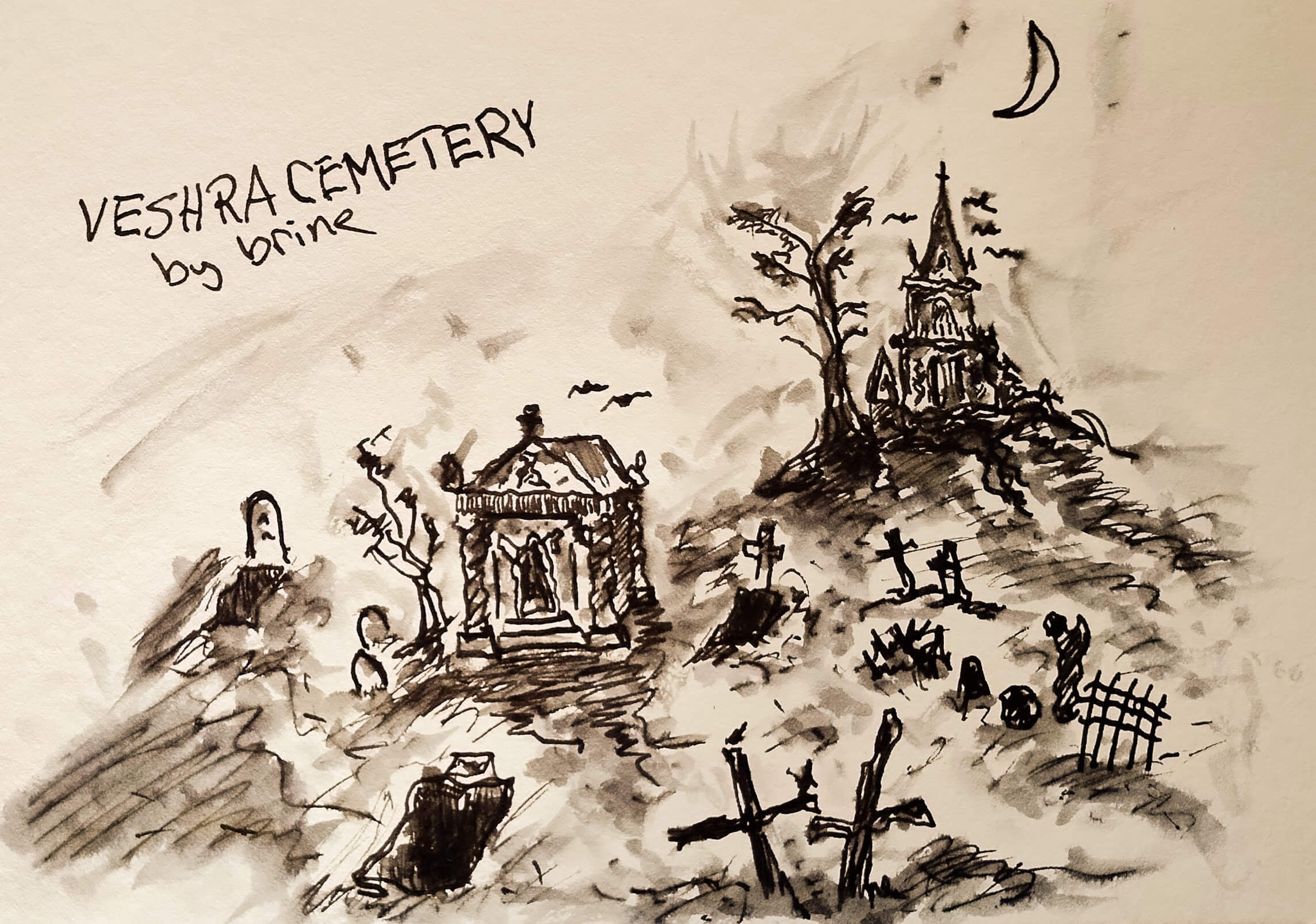
Fog chokes Veshra Cemetery. Monuments lean at drunken angles and a half-collapsed chapel marks the cemetery's northern edge. At its center, three excavated graves form a triangle around Lady Veshra's monument.

A robed figure sits on a stool near the monument, dark lantern at his feet. Tea service arranged just so on a headstone. The Steep Mage sips from fine bone china while his gravediggers work, their spades biting into consecrated earth. His shadow looms over the marble, rocking ever so slightly as he mouths a verse over and over.

But the cemetery itself betrays him. Sentinel Crows are its eyes; Grief Wraiths its vengeance. Veshra's descendant is here for her inheritance. And breaking Lady Veshra's coffin seal releases the wraiths, who protect the cemetery and the Soulstone from disturbance.

But the Steep Mage is not alone. His murdered wife has returned as a Dybbuk; a desperate spirit who possesses the living. She haunts the chapel, trying to help him succeed. Tonight is their last chance.

Tonight he joins his true love in life or in death.

As the PCs approach the cemetery gate, mercenaries lean against the pillars, passing a flask. One mutters "Where is she?" They are puzzled by your arrival...

Who Are You?

  • Possessed: The Dybbuk found one of you first. She slipped inside you like burning ice water, and now you're drawn toward the monument. You still have some control, but she's stronger when you're emotional or tired. She needs you to help him complete the ritual. You feel her grief; her desperation. Sometimes you speak in her voice. Sometimes you can't remember what you just did.
  • Veshra's Bastards: You share Vira's blood but not her title or inheritance. The Soulstone should be yours by right of kinship. You arrived early to claim it before your "dear cousin" and her hired thugs. You know the cemetery's layout from childhood visits before the exile. The crows remember you, but you're not sure if that's good or bad.
  • Magistrate Flunkies: The magistrate reluctantly sent his "best agents" to assess the situation. Vira came to him with wild accusations of grave desecration and dark magic. He thinks she's batshit crazy but if things go badly, you have the authority to act.
  • Grave Tenders: You maintain Veshra Cemetery. You know every name on every headstone. You've felt the cemetery's eye for years. You put flowers on the Paupers' Pit. The cemetery called you here...

read more

Conversation-First Roleplaying

2025-11-25

After a hiatus, I'm back podcasting about TTRPGs. I'll continue to post actual plays I'm part of, but I've also launched a new series centered around what Whitebred and I refer to as Conversation-First Roleplaying.

"We start with the conversation, then we add rules to the conversation."

And to prove we eat our own dog food, the podcast itself is just a conversation. No scripts! We just said "podcast" and hit record.

What If RPGs Came From Storytelling Instead of Wargaming?

Imagine a world in which roleplaying grew from storytelling. Just a conversation with rules added only when needed. Instead, many games feel like board games or wargames with a little roleplaying pasted on top.

D&D came from wargaming: referees managing units, stats for everything, rules to adjudicate combat. People added roleplay later. That foundation is still there: you check your character sheet for permission, calculate modifiers, then describe what the numbers mean.

We flip it. The conversation comes first. Characters talking, making choices, using the world around them. Rules only show up when they help—when there's risk, when stakes matter, when we need to find out what happens next.

Get the Math Out of the Way

Looking at a character sheet or flipping through rules breaks the flow. You're in the middle of a tense moment and suddenly you're doing arithmetic. It pulls you out of the world.

That's why both our games use Names (epithets) instead of stats.

  • In Named, Names describe who the characters are and what they can do
  • In Of Yarn and Bone (OYAB), your character is a product of the world, defined by their role, their past, or what people whisper about them

If you're a "Reluctant Captain" or "The Ship Thief," I don't need a number to tell me if you can sail a boat. The conversation tells us. We only roll dice when it's risky or the cost is meaningful.

Someone asked Whitebred recently: "How do you handle flashbacks?" His answer: "We just do them? It's now a month ago." If it makes sense in the fiction, you don't need a rule for it. Don't hunt for costs to charge people.

Mechanics Are Conversation

The best mechanics don't stop the talking; they structure it.

Take Reflections, for example. Instead of calculating XP at the end of a session, we discuss each character in turn. Did the character change? Does the world see them differently? Have their Names changed? Did you earn a new Name? Should we upgrade one? Did you prove you're not actually a pacifist?

Characters emerge naturally through play. You're not adding numbers to a character sheet, you're discovering who they are by what they do.

We do the same thing with magic. In OYAB, there are no mana points or spell slots. A mage "petitions the world for indulgence," asking air, stone, water, fire to do what they naturally want to do. Stones gather. Water reflects. Vines tangle. It's about the relationship between the caster and the world, not a resource economy.

When a spell fails, you can take on a Burden, represented by a tarot card. Not a mechanical cost, but narrative debt. The world will be repaid! The card sparks conversation: what does this mean? How will this come back? That's the magic system. A conversation about consequences.

Just Play

Don't worry about getting it "right." This isn't a manifesto or a movement. It's just how we play.

Steal the ideas you like. Treat your game like a toolkit. Sit down with people who want the same kind of game you do, figure out who you are in the world, and start talking.

Rule Zero from Of Yarn and Bone says it plainly: "By the powers vested in me (which are none), I give you permission to do anything that results in a better game."

If a rule gets in the way of the conversation, kill it. If a mechanic helps structure the conversation, keep it. The game is yours. Play it your way.

#conversation_first #named #oyab #unnammed_worlds #ttrpg

E1 Unnamed Worlds, Tarot Magic, and Conversation-First Design

2025-11-24

thumb

This is the first episode in a new series of conversations between myself, Wightbred and whomever else. We talk about Wightbred's new zine, Unnammed Worlds; the magic system in brine's game Of Yarn and Bone; why we like narrative-first, conversation-driven ttrpgs, and a number of other rambling topics.

  1. By the powers vested in me (which are none), I give you permission to do anything, change anything or ignore anything that results in a better game for you and your players. Forever.

#podcast #wob #named #oyab #ttrpg

An Unfamiliar World

2025-11-9

Based on Richard Williams' Unfamiliar and adapted for use with Of Yarn and Bone.

The Broken Bond

Your character was once a mage's familiar but is now a stray living in the wild. The communion between mage and familiar is severed, but the world remembers what you were. You carry that memory like a scar, visible only to those who can see.

Marked

Unfamiliars are marked by magic. They can still cast Promises—small, ephemeral magics the world takes for granted. Anything greater and the world just... tilts its head, uncertain whether to listen.

Other animals sense the mark. Predators hesitate. Prey stare too long before bolting. Unfamiliars are tolerated curiosities, feral things caught between worlds—feared, yet when danger comes, even natural enemies instinctively call upon their marked brethren.

In the World

Magi might see Unfamiliars as living Totems—creatures literally of the magical world who could amplify spells. Or as Walking Burdens, remnants of a broken promise between mage and world. Desperate magi might even attempt to transfer their own Burdens onto an Unfamiliar, using them as unwitting vessels in rituals meant to restore balance. Sanctuary is most likely found with those at the margins—human children, beggars, the lost, the Fae.

These animals travel together out of survival and kinship and an uneasy trust—predator and prey, side by side.

They are feral, marked, tolerated curiosities in a world that isn't quite sure what to do with them.

At the Table

  • Unfamiliars should have at least one Name echoing their familiar life: Once Called Nighthawk, Shadow of the Covenant, Bound to the Thornwood, Remembers the Words
  • Animals retain their natural skills but are not human: they don't carry things in pouches; they don't have rations or gear in the traditional sense. A crow has its beak and talons. A cat has claws and grace. Play them as the animals they are.
  • Casting with Totems means bargaining with a world that isn't sure it should listen. Spells may be less effective and will require a more feral approach to Totems: being bitten by a graveyard snake, rolling in ash from a burned church, carrying a dead thing in your mouth, clawing symbols into bark.
  • Unfamiliars can speak to one another and understand human speech, but this understanding is one-sided. The world of men can be cruel to animals; you will need to watch each other’s backs.

#oyab #unfamiliar #ttrpg

Of Yarn and Bone

2025-10-23

Of Yarn and Bone is a conversation-first game of identity with stakes, magic with awe, and play with trust.

WHO IN THE WORLD ARE YOU?

Your character is a product of the world; they start with three Names that describe their place in it. Names are epithets that might be a role they fill, an identity or something whispered about them. They are actionable, used in play, and may change or be awarded (up to six total).

  1. Create three Names that define your character; here are some prompts to help:
  • What role does your character have in the world? eg. Reluctant Captain, Aging Herbalist, The Fixer
  • Anything from their past? eg. Orphaned Princess, Butcher's Daughter, Owes a Blood Debt
  • What trait describes them? eg. Ruthless, Haunted, Unshakeable
  • Do they have a strong relationship? eg. Widow's Son, The Last of My Line, Sworn to Protect Her
  • Are they known for something? eg. The Witness, Ship Thief, Speaks With Stones
  • Do they own something of note? eg. The Good Ship Revenge, My Father's Blade, The Broken Crown
  • Do they have a strong belief? eg. The Land Remembers, No Gods No Masters, The Way of the Snail
  1. Write down three words that describe your character's look, features or vibe
  2. Name your character

Your character has typical gear based on their Names. Consider making extravagant gear a Name.

The GM represents the world. When uncertain, talk it through.

read more

Updating My Magic System

2025-8-24

I'm updating my magic system, including the original post that describes the system narratively (sorry if this annoys). I thought I'd also walk through it a bit in this post...

The goal is a magic system that feels magical; no easy task. I took elements from my favorite magic systems: Jonathan Strange and Mr. Norrell and A Wizard of Earthsea. Magic is like music: some can, some can't; some read, some intuit. Magic is of the world... a mage asks favors of it and/or does favors for it.

  • ask a stone to gather its brethren and create a road
  • ask the air to withhold itself from a creature until it is unconscious
  • ask a still lake to reflect a scene its been witness to
  • ask the moon to hold back the tide
  • help tell the story of a misdeed that a forest or church or statue cannot alone

Totems can also spark a player's creativity for spells for their mage:

  • bark from a hanging tree
  • a stone from an enemies castle
  • any manner of items found in an apothecary
  • a king's slipper
  • a coin from a beggar's cup

Burdens are ballance in the magical world (Earthsea). Representing them with tarot is part GM/Player support and part... well... mysticism? They're an oracle for storytelling, and give consequences a symbolic, narrative hook instead of being just a penalty.

Promises are like cantrips. Any mage worth his socks should be able to cast these simple, ephemeral spells. Substantial magic requires Rituals that can take days, weeks or even months. And then Summoning is the crazy train of opening yourself up to the whims of the Fey. Eg. only they can bring life back to the dead?

I try to provide just enough structure and support, while leaving it open to interpretation and creativity at the table. It certainly won't be for everyone... and perhaps not even anyone but me :D

#magic #oyab #ttrpg

On Magical Magic

2024-2-13

From the memoirs of Rown Varkana - Mage, Council of Six @Yagul Fane...

I have no skill with quill or ink, but my wife insists I write. "Who should know of you if you don't?", she says. "I am a mage on the Council of Six", I reply! I neglect to tell her I've spent the better part of an hour trying to get this quill to abide my commands and write for me. Alas, and more time still cleaning up the mess. This empty page vexes me.

I suppose the place to start is at the beginning. Fine. What is magic? It's quite simple really: the world is full of magic and a mage communes with the world. Air, tree, stone, ocean, star; all allies of the mage. With proper knowledge, a mage may petition the world for indulgence; favors if you like. Given their relationship is in good standing, the world is likely to comply.

Magi are born with this gift but it requires development. Some learn spells from tomes and scrolls while others may intuit them. But this development takes time. The Fae, with their long lives, are the most knowledgeable in magic. They enjoy the deepest bonds with the world. If their magic has boundaries, they are unknown to me but with long life comes madness. Pity the mage that must bargain with a Fae; it's like treading on shifting sands.

The world has a mind of its own, and so too does magic. One rolls the dice when casting a spell [2d6 or 3d6 for circumstance or legendary skill]. A mage may tip the scales, so to speak, but at a cost. Balance will be restored one way or another. A mage feeling a spell failing may accept a Burden [represented by a tarot card] and have it succeed instead. How the Burden is satisfied is anyone’s guess, but rest assured, it will call on the mage in time. Particularly poor castings can invoke failure and a Burden [rolling snake eyes]. A mage can endure only three before being lost in the world.

Promises--the simplest spells--wield significant potential in the hands of a cunning mage. Often dismissed as "cheap tricks," their ephemeral quality leaves no lasting impression on the world. Yet, they signify an unspoken agreement; a remnant from the bond between mage and world.

More advanced spells demand a Totem—something physical of the world and a representation of the intended outcome. While a totem should ideally resonate with the desired effect, substitutions are possible. Salt is renowned for its ability to ward off malevolent energies. However, alternatives like chalk or even ground coffee may serve adequately.

Furthermore, Enhancement Spells, cast in tandem with a primary spell, can amplify potency, duration, or scope. They enhance a spell's efficacy but take time [ie. an extra turn] and compound the risks of casting—an additional Burden for the mage who pushes both.

Rituals are the pinnacle of magical prowess. They yield unparalleled power but demand patience and dedication. Alternatively, one might venture into the perilous realm of Summoning. But bargaining with a Fae comes with great risk and success is far from guaranteed.

~ R

#magic #oyab #ttrpg

Southern Coast - 04 A Better Door than a Window

2023-12-23

thumb

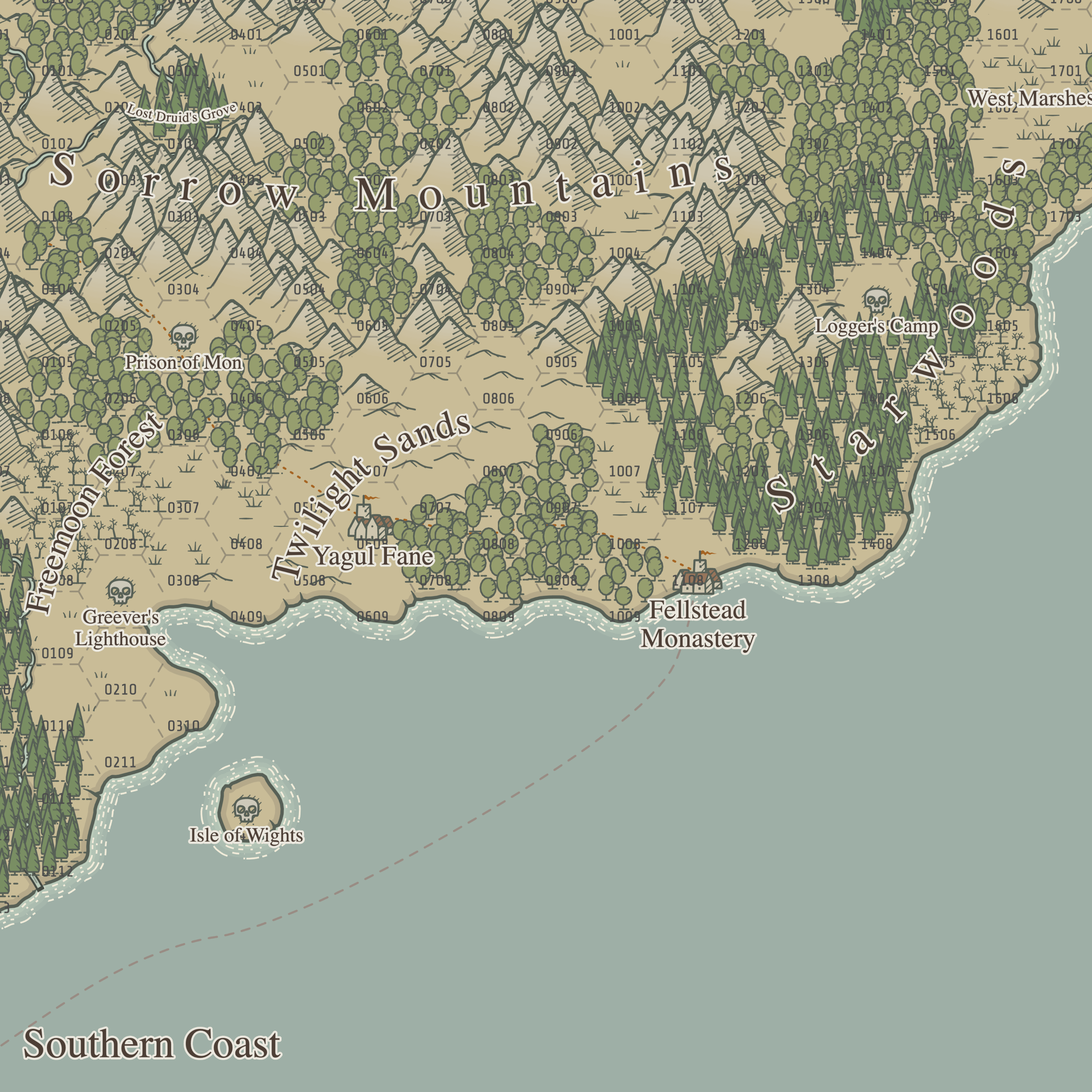
An actual play using Of Yarn and Bone; recorded live on the Play Worlds Discord server.

In our final episode of The Southern Coast, Hergest leaves the Prison of Mon and finds not one, but two familiar faces... or is it three?

map

  • brine - GM
  • Paulo as Hergest the Healer Herbalist Well-traveled, Old

#podcast #actual_play #oyab #south_coast #ttrpg

Southern Coast - 03 The Prison of Mon

2023-12-01

thumb

an actual play using Of Yarn and Bone

Hergest travels alone to The Prison of Mon to find help with a fell beast. He hopes The Hag Kalg--a prisoner there--might provide some answers. Two comrades remain at the logger's camp; infected with an insatiable hunger. Using magic, Hergest has taken on part of their burden.

Note: due to audio issues, session 2 has been lost

map

  • brine - GM
  • Paulo as Hergest the Healer Herbalist Well-traveled, Old

#podcast #actual_play #oyab #south_coast #ttrpg

Southern Coast - 01 The Mad Monk

2023-11-26

thumb

an actual play using Of Yarn and Bone

Hergest travels to Fellstead Monastery on the Southern Coast. He's asked to check in on a Logger's Camp in need of healing. He is accompanied by Sir Ealdred, and Brother Estabar, and on their way, they meet The Mad Monk...

map

  • brine - GM
  • Paulo as Hergest the Healer Herbalist Well-traveled, Old

#podcast #actual_play #oyab #south_coast #ttrpg